THE CHEATS FILES: OH MY CHIHULY – AMAZING PHOTOS FROM THE VMFA
Like most of you…I drove, or walked, pass the VMFA a million times since October saying, “Yo…I have to check out the Chihuly exhibit…someday.” Well, I started with having, what seem to be, an eternity to, “Oh snap…it’s the last weekend.” Should I go and fight the crowd or sit this one out? I decided to break out the camera and hit the last Saturday of the exhibit. I’m so glad I did. Everyone in RVA should have seen this exhibit and judging by the very impressive numbers of the VMFA (nearly 16,000) so many of you did.
What impressed me the most about the exhibit was the imagination. Art takes all forms. With Chihuly, his work can never be put in a box because as soon as you do – he can change it up. It’s awesome. It’s freedom.
According to the RTD: “Chihuly proved to be a boon for the museum. Memberships reached nearly 40,000 — it was at about the same level during the Picasso exhibit at the VMFA in 2011 — and the Museum Shop had record sales in November, December and January.” I saw the Picasso exhibit (again on the last weekend), and I would say Chihuly was even more impressive. I know it’s not exactly comparing apples to apples but my read of the “Cheats Wow Factor”…Chihuly was a wow on the highest level.
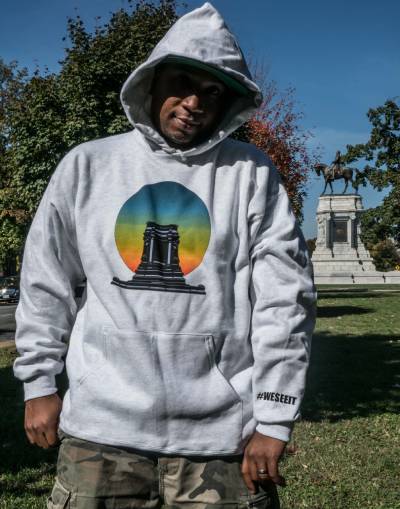
Make sure you visit: The Cheats Movement Blog on Facebook to support the best in RVA. #WESEEIT
THE MANIFEST FILES: BLOOD ON THE COBBLESTONES, RICHMOND’S ROLE IN THE SLAVE TRADE
Archaeologists excavated the Lumpkin’s Jail near Shokoe Bottom. photo courtesy of the Richmond City Council Slave Trail Commission.
Words by Duron Chavis (Brother Manifest)
Richmond is a very complicated place. Despite how complex its history, the one thing that is indisputable is that Richmond was once the biggest enslaved African trading industry outside of New Orleans. One can’t begin to part lips to speak on Richmond as a historical city without taking a moment of silence over its role in the Maafa, or African Holocaust. Why Richmond though? What made Richmond such a pivotal place for the traffic of human beings? There is so much to talk about on this topic, for the sake of brevity and your attention span I am going to get straight to the point. Richmond made a name for itself as the market for enslaved Africans.
The earliest sales of kidnapped Africans took place at Manchester Docks in areas such as Rocketts Landing. During the 1700’s the importation of kidnapped Africans was seen as a lucrative business opportunity by British merchants. Once the country broke revolted against Britain in 1775 and gained independence in 1782; the question of whether importing kidnapped Africans from overseas was raised, not from the stance of whether it was morally destitute to keep African people in perpetual servitude – more so if it was financially savvy to keep importing them from overseas. In the North, they built ships to import kidnapped Africans. In Virginia, the argument was raised that if the importation stopped the financial value of the children of kidnapped Africans would rise. The Virginia General Assembly outlawed the importation of kidnapped Africans in 1778. The federal government outlawed the practice 30 years later in 1808.
Virginia saw a vision for African people in the late 1700s and that was as a commodity. The expansion into the lower South gave rise to states such Louisana, Alabama, Mississippi and Texas. The tobacco that had made the original colonies successful was failing due to depleted soils from over cultivation of the land. Planters decided to move south. They took the children of kidnapped Africans with them and the interstate slave trade exploded with these migrations due to the ban on importation. Historians theorize that the origin of the term being “sold down the river” has its origins in Virginia, for much of the work in the lower south cotton fields was so intensive. It is estimated that from 1830 to 1860 Virginia sold 300,000 of the progeny of kidnapped Africans into the lower south for perpetual bondage. Wealthy plantation owners took advantage of the ban on importation. Virginia was known as a slave trading state and Richmond was its capital.
By 1845, less than 40 years after the ban on importation of kidnapped Africans – the city of Richmond listed 9 agents associated with the slave trade. By 1860 it listed 18 negro traders, 18 agents and 33 auctioneers all of whom were in the business of selling enslaved Africans. The Richmond Enquirer reported in 1857 that the receipts for slave auctions in the city totaled $3.5 million dollars. If we calculate for inflation that is the equivalent of $92,000,000 dollars today.
The sale of enslaved Africans was big business. There were large traders, small traders, agents, brokers, jail houses and auctioneers not to mention specialty retail merchants that sold the chains and shackles. You remember the movie Django right? Remember in the opening scene where you saw the shackles on the feet of Django and the rest of the coffle? A coffle was group of slaves that were manacled together and walked to auction for sale while attached to a wagon. Somebody specialized in selling shackles. Somebody specialized in selling clothing for enslaved Africans, because when sold at auction they would get a much better price. You had people who sold enslaved African women as sex slaves, domestic servants, concubines and prostitutes. Businessmen specialized in being bounty hunters or paddy rollers to capture runaway enslaved Africans. There were insurance salesmen who would insure an enslaved African as someone’s property or as part of their estate. There were ships that were contracted to transport slaves down the river and along the coast lines. Railroads companies were used to do the same. There were ad agencies that advertised the auctions. The physique, specialty, skill, mental ability or training and temperament all played a role in determining price and there were businesses that catalogued and assessed what characteristics an enslaved African had in order to determine how much he or she would be sold for. The purchase and sale of enslaved Africans was interwoven into the very fabric of the city.
Auctions took place in the streets, taverns and hotels of Shockoe Bottom. The most infamous jail was Lumpkins jail – located at 15th street between Franklin and Broad Street. Countless enslaved Africans passed through the jailhouses as they awaited sale. The African Burial Ground on the opposite side is where Africans who died in the jail from diseases, or were too rebellious and were hanged. Free blacks were also buried in the African Burial Ground. Gabriel, an enslaved African who led a rebellion in Richmond, Virginia with a plan and strategy to kidnap the governor and hold him hostage was also hanged and it is said he is buried in the African Burial Ground as well. It is only recently within the last 3 years that the African Burial Ground has been recognized by the city officially and there has been no archeological studies on the site to determine the size and scope of this mass grave.
Each time I walk in Shockoe Bottom, when I walk past the farmers market on 17th Street – when my feet hit those cobble stones, I think to myself these are the same cobblestones my ancestors feet walked on in shackles to be sold to the highest bidder. I walk past restaurants and clubs and think to myself – these places of entertainment and food were once boudoirs and auction houses. I visited a similar farmers market in London England that had the same exact cobblestones and design as Shockoe Bottom. The offices used to hold businesses that made their profit on the backs of my ancestors, for I am the progeny of enslaved Africans – living in Richmond Virginia. Slavery was an international business that localized itself in the states particularly Richmond ,VA to maximize its profit margin. Each time I pick up a magazine that promotes Richmond as a historic city – I crack a half smile – understanding that the whole story is hardly ever told. When I hear about plans to rebrand the city – that gloss over one of the most important aspects of the cities past – I say a silent prayer that one day we will realize we can’t run from this history; it lives with us to this day. When I think about the systemic poverty in the city, the disparity between those who have and those who have not – I remember that the roots of that disparity were created right here in Richmond, Virginia.
Take a moment to review the work of the Richmond City Council Slave Trail Commission. CLICK HERE
Duron Chavis (Brother Manifest) is the director of Happily Natural Day and coordinator of the Mcdonough Community Garden. He will be writing about RVA Black History every Friday this month.
WHERE MY DOGS AT? DMX ROCKS THE NATIONAL [PHOTOS]
“Flesh of my Flesh, Blood of my Blood, Ruff Ryders, and of course, This is not a F-in Game,” all chants synonymous with the legendary rapper DMX. The Grand Champ took the National stage last night to a very enthusiastic crowd. X did not waste any time going right into the string of hits that made him one of the biggest emcees of the late 90′s and early 2000′s. He performed nearly all of his popular songs from his 7 albums, normally performing one or two verses from each song while the DJ kept the pace moving. X, the ultimate showman, showed tons of energy – despite saying that he had just gotten off of 3 planes. He interacted with the crowd, often joking with members in the audience, pulling women on stage (yes he did), and he even poured a bottle of Hennessy on the front row. To the dismay of National security, at one point X climbed on the large speaker system on the side of the stage to launch into the Ruff Ryder Anthem.
He controlled the stage at every moment with ease. He ripped through songs like: “Get At Me Dog,” “Who We Be,” and “Party Up.” He slowed it down with, “Slippin.” As always, X ended the show with a prayer and left the crowd chanting for more. Also, S/O to the homie Black Liq and The New Juice Crew for always representing RVA on stage. The man works hard.
HEY RVA, WHATCHA KNOW ABOUT: THE ARTISAN CAFE [VIDEO]
The ARTisan Cafe is a unique shopping and social experience that happens seasonally in RVA. Created by Melody Joy Short and Adrienne Cole, their goal is to fill a noticeable void in the city by presenting a diverse range of independent artist and vendors offering one of kind goods and services. Featured in the March issue of Essence Magazine, and just recently announced as a finalist in the i.e. start-up competition, Melody and Adrienne are looking to build on their strong momentum and growing support in RVA. The next Artisan Cafe is Saturday, June 16 at Plant Zero Art Center. It starts at 6:00 PM.
CHEATS MOVEMENT SPECIAL: ARTS IN THE ALLEY [GUEST POST BY JEANINE GUIDRY]
Style Wars Summer Continues: Check out this great guest post from Jeanine Guidry, Executive Director of Arts in the Alley
With all the mural-painting taking place in Richmond this month, you may have missed one project: Arts in the Alley. Arts in the Alley is a project of local nonprofit Offering, and on April 14-15 we hosted our sixth event in Greater Fulton in Richmond’s East End. During Arts in the Alley, volunteers clean up a run-down alley or block and revitalize it by painting murals on its walls. Usually, we have between 75-125 volunteers – this time, we were blown away with more than 325!
Families are welcome at Arts in the Alley – our youngest volunteer was 24 months old…. she brought a crayon
. Our most dedicated one? Near the top must be little Mia – five years old, and already an Arts in the Alley veteran. Mia has been to the past two Arts in the Alleys (with her family, of course) and each time cleaned and primed and painted more than 7 hours. What Mia is teaching me? You are never too young, too old, too…. anything to make a difference.
Paint may not change the world, but people and paint can change things. They can makes dirty buildings prettier. They can make boring walls more interesting. They can make dark places brighter. They make a group of people who have never met before turn into a well-balanced team. They change a little girl into a community worker. Little boys, too. They brighten neighborhood and they brighten hearts. Together, people and paint can turn strangers into friends. Here are some photographic impressions (courtesy of the amazing and generous DJ Glisson at Firefly Imageworks. Want to get involved? Just click HERE.
Jeanine Guidry, Executive Director, Arts in the Alley
What Mia is teaching me? You are never too young, too old, too…. anything to make a difference.
PHOTO: America, Rainbows, and Trailers!
2011 Galax Fiddlers Convention! That’s right RVA - I was there!